Your Stone Was Beautiful Once. It Still Is — Under the Wear Layer.
Professional honing and polishing for marble, granite, terrazzo, and travertine. We restore the stone itself — removing etching, scratches, and traffic paths mechanically — rather than hiding them under a coating that fails in months.
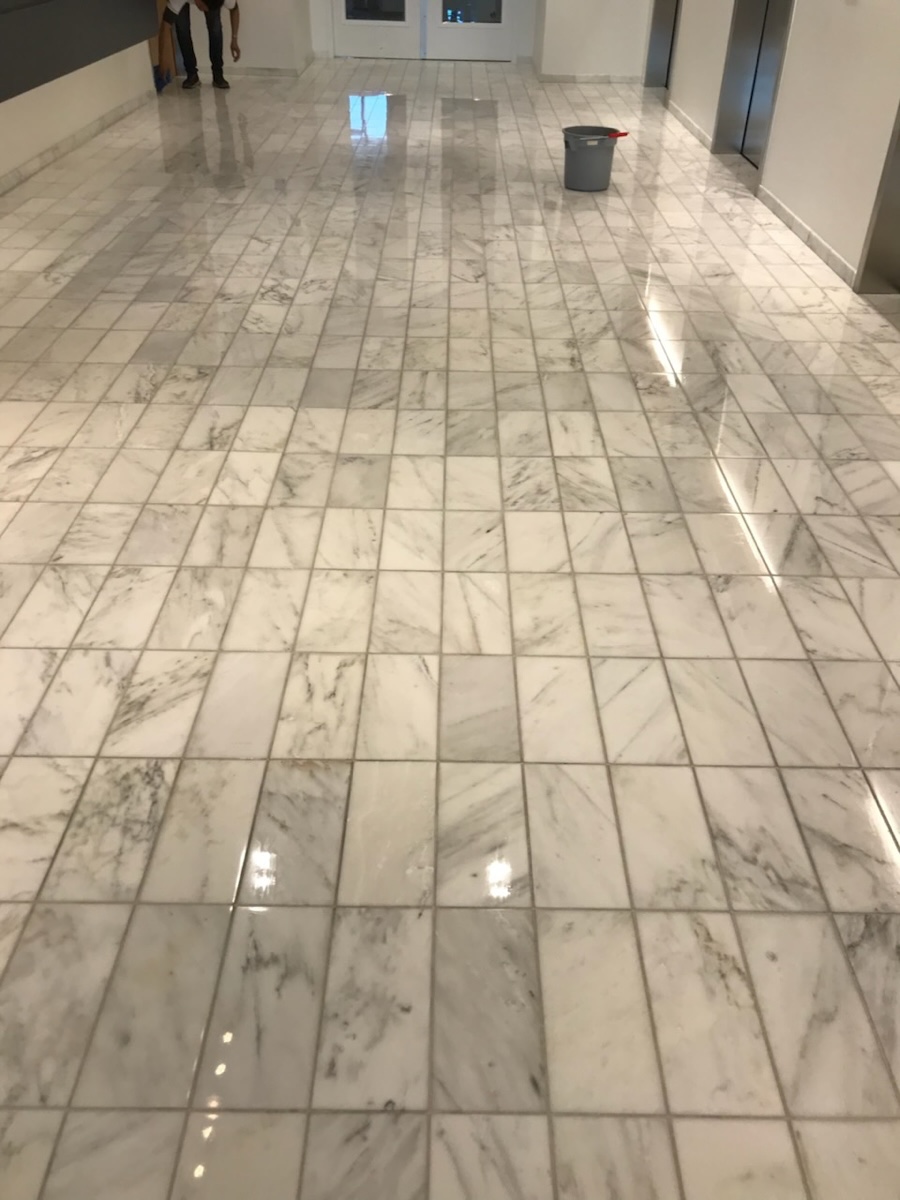
Natural stone dulls in a predictable way: foot traffic abrades the polished surface into gray walk paths, acidic spills etch marble and travertine, and well-meaning cleaning crews make it worse with the wrong chemicals. The fix is mechanical, not chemical. KCS restores stone with diamond honing — weighted floor machines running progressively finer diamond abrasive pads that cut below the damage — followed by powder polishing with polishing compounds that bring up the stone's natural reflectivity. No topical waxes, no acrylic coatings, no film to yellow and peel.
More about stone polishing
Each stone gets its own protocol. Marble and travertine are calcite-based and etch-prone, so they get full honing progressions and marble-specific polishing powders. Granite is far harder and needs different diamonds and compounds. Terrazzo — common in schools, churches, and mid-century lobbies — responds beautifully to honing and densification, often revealing a floor owners assumed was beyond saving. After restoration we apply a penetrating impregnating sealer that resists staining while letting the stone breathe.
Restoration is the expensive visit; maintenance is the cheap one. We put restored floors on scheduled maintenance polishing — periodic light honing or powder polishing of traffic lanes — that keeps lobbies, corridors, and restrooms at full clarity for a fraction of restoration cost. KCS services commercial stone across the East Bay, Tri-Valley, downtown San Francisco, Solano County, Sacramento, and the Central Valley.
What's Included
Diamond Honing Progressions
Weighted machines and graduated diamond abrasives cut beneath scratches, etching, and wear paths to a uniform, damage-free surface.
Powder Polishing
Stone-specific polishing compounds restore the natural mirror finish mechanically — the traditional method, done correctly, with no topical film.
Etch & Stain Correction
Acid etching on marble and travertine, water spotting, and many stains are removed or dramatically reduced during the honing process.
Terrazzo Restoration
Ground, honed, densified, and polished — terrazzo in schools, churches, and older buildings restored to its original intended finish.
Impregnating Sealers
Penetrating sealers protect restored stone from staining without changing its appearance or breathability — no waxy buildup, ever.
Maintenance Polishing Programs
Scheduled traffic-lane honing and polishing keeps restored stone at full clarity year-round and pushes the next restoration years out.
How It Works
- 1
Stone Assessment
We identify the stone, measure the damage — etching, lippage, wear, prior coatings — and confirm what restoration can achieve.
- 2
Test Spot
On significant projects we hone and polish a test area so you see the achievable finish before committing to the full floor.
- 3
Flat Quote & Scheduling
Fixed pricing for the defined area and finish level, scheduled nights or weekends around your building's hours.
- 4
Hone, Polish & Seal
Diamond honing progression, powder polish to specified sheen, and penetrating sealer application.
- 5
Maintenance Plan
A written care protocol — correct daily chemistry for your janitorial crew plus a scheduled polishing cadence.
Stone Polishing FAQs
Can etched and dull marble really be restored, or does it need replacement?
It can almost always be restored. Etching and wear live in the top fraction of a millimeter; honing removes that layer and polishing restores the finish. Replacement is rarely justified — and we will tell you plainly if your floor is the exception.
How do you price stone restoration?
Assessment first, then a flat quote. Stone type, damage depth, square footage, and target finish drive the hours. On larger floors we do a test spot so both sides know exactly what result the price buys.
Why not just apply a glossy coating over the stone?
Coatings on natural stone are a short-term trick: they scratch faster than stone, yellow, peel, and trap moisture. Mechanical restoration fixes the actual surface. It costs more once and then costs far less to keep.
Our janitorial crew has been using an all-purpose cleaner on the marble. Is that a problem?
Very likely, yes — anything acidic or highly alkaline dulls calcite stone over time. Part of every restoration handoff is a simple care protocol: neutral pH cleaner, correct pads, and what never to let touch the floor.
How long does restoration take and how disruptive is it?
Most lobbies and corridor runs are done in one to three nights. The process is wet but low-odor and machine-based; we contain the work area, and floors are usable the next morning.
How often does polished stone need maintenance?
Traffic lanes in busy lobbies benefit from maintenance polishing two to four times a year; lighter areas may need annual attention. A maintenance program costs a small fraction of restoration and keeps the floor consistently at its best.
Free walkthrough · Flat quote
Ready to talk about stone polishing?
Tell us about your building and we'll schedule a free walkthrough — then send a flat, no-surprises quote.